
Asset Sale vs Stock Sale Tax Implications for Business Owners
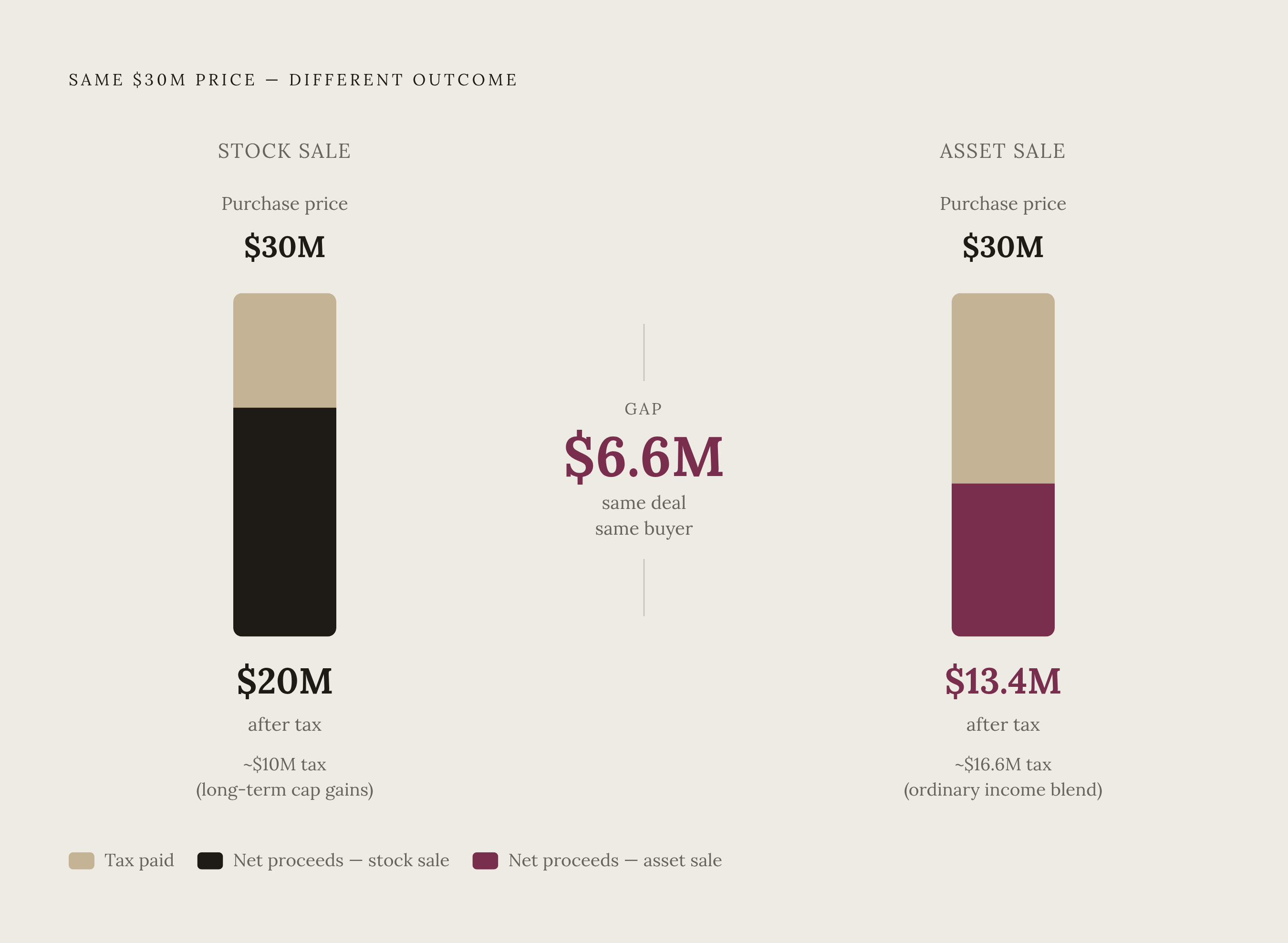
The deal structure can shift $6.6 million in after-tax proceeds between identical $30 million sales.
Selling a business comes down to a tax arithmetic problem long before it becomes a legal one. Two owners can sell for the identical $30 million, to the identical buyer, and walk away with after-tax proceeds that differ by millions, purely because of how the deal is structured. Wayne Zell lays out exactly this scenario in his writing on the subject: one seller nets roughly $20 million, the other $13.4 million. Same price, same buyer, different structure. That gap is the predictable output of a tax code that treats stock and assets differently, and it is why the structural choice, not just the price, deserves the bulk of the negotiation.
An asset sale versus a stock sale typically shifts somewhere in the range of 10 to 15 percent of after-tax proceeds between buyer and seller, and sellers who let the buyer set the structure without a fight are leaving money on the table before the lawyers even start drafting. An asset sale versus a stock sale typically shifts somewhere in the range of 10 to 15 percent of after-tax proceeds between buyer and seller. That's the number to anchor on as the rest of this gets technical.
The federal rate gap that makes structure worth negotiating
Everything downstream of the stock-versus-asset decision traces back to one fact. The federal government taxes ordinary income and long-term capital gains at meaningfully different rates, and a business sale can generate either, depending on how it's built.
For 2026, long-term capital gains rates run at 0% up to $94,050 for married filers ($47,025 single), 15% from there up to $583,750 married, and 20% above that. High earners, those with net investment income above $250,000 married or $200,000 single, also owe the 3.8% Net Investment Income Tax, pushing the effective top federal rate on long-term capital gains to 23.8%.
Ordinary income works differently. The top rate is 37%, kicking in above $640,600 for single filers and heads of household, $768,700 for married filing jointly, and $384,350 for married filing separately.
Do the subtraction and the gap holds up: capital gains at 23.8% against ordinary income at 37%. That spread is the entire engine behind why buyers and sellers pull in opposite directions on deal structure. Neither side is being unreasonable here. Both are responding rationally to the same tax code, just from opposite ends of the transaction, and pretending otherwise only slows the negotiation down.
Why buyers dislike how a stock sale is taxed for the seller
A stock sale, from the seller's side, is about as clean as tax treatment gets. The seller sells shares held more than a year, and the entire gain gets taxed once, at long-term capital gains rates: 20% federal, plus the 3.8% NIIT for high earners, for a combined 23.8%. There's no recharacterization into ordinary income, no mosaic of asset classes taxed at different rates. It's a single number on a single line.
There's also no purchase price allocation to fight over. Form 8594, the document that splits a deal into asset classes for tax purposes, doesn't apply to a standard stock sale, because there's nothing to allocate. The seller hands over stock, the buyer hands over cash or other consideration, and the gain is the gain.
Stock sales carry another benefit for the seller that has nothing to do with rates: liability. Once the stock changes hands, everything sitting inside that corporate shell, contracts, pending litigation, environmental exposure, employment claims, travels with the company to the buyer. The seller walks away clean, even from problems that haven't surfaced yet.
Buyers know this, and that's why they resist it. A stock sale means inheriting the seller's historical basis in the underlying assets, often a basis that's been depreciated down to near nothing over years of ownership. There's no step-up, no fresh depreciation schedule, no new amortization deductions on whatever premium the buyer paid over book value. Goodwill purchased above net asset value sits on the buyer's books, undepreciated, until some future sale finally lets them recover it. Layer on top of that the fact that the buyer has now absorbed every undisclosed or contingent liability the target ever created, and the buyer's reluctance stops looking like squeamishness. It's plain self-interest.
Why the mix of rates is the hard part in how an asset sale is taxed for the seller
If the structure is flipped to an asset sale, instead of one number, the seller now faces an accounting exercise. Some of the proceeds get taxed at capital gains rates. Some get taxed as ordinary income, at rates up to 37%. Which bucket a dollar falls into depends entirely on what asset it's attached to, and how the total purchase price gets allocated across the business.
Inventory generates ordinary income, taxed on the markup over the seller's basis. Accounts receivable, if it hasn't already been booked at full face value, throws off ordinary income too. Equipment, vehicles, furniture, anything classified as Section 1245 property, triggers depreciation recapture: the seller pays ordinary rates on however much depreciation was claimed over the years of ownership, before capital gains treatment applies to anything above that.
Goodwill is where sellers want their value parked. Goodwill and going concern value, classified as Class VII under Section 1060, generate long-term capital gain, and so do Section 1231 assets, mainly real property and other long-held business assets, held more than a year. That's the seller's preferred category, and for good reason: it's the only place in an asset sale where the 20% rate, not the 37% rate, does the work.
Zell's book walks through an example involving a seller named George that makes the granularity concrete. $2 million in net accounts receivable, taxed at 37% instead of 20%, costs roughly $340,000 in extra tax, on that single balance sheet line alone. Nothing about the deal itself changed. The number moved because accounts receivable simply doesn't qualify for capital gains treatment, no matter how the rest of the sale gets negotiated.
The C corporation double-taxation problem and entity type
Entity type turns the asset-sale math from uncomfortable into genuinely punishing, and C corporations take the worst of it, no exceptions. When a C corp sells its assets, the gain gets taxed once at the corporate level, and then again when the remaining proceeds get distributed out to shareholders. Two layers of tax on the same dollar of gain, and the combined federal rate on that gain can clear 40% before state tax even enters the picture.
Consider a $1 million asset sale with a $200,000 basis, leaving $800,000 of taxable gain. A high-income S-corp shareholder in California, subject to combined federal and state tax, ends up paying roughly $297,600, netting $702,400. Running the identical transaction through a C corporation nets the same seller somewhere around $440,000 to $480,000 after both layers of tax hit, losing close to half the gain to the corporate structure itself.
More than 90% of C corporation acquisitions get structured as asset sales. The overwhelming majority of C-corp sellers run headfirst into this exact problem, frequently without enough lead time to do anything about it through pre-sale planning. If there's a single entity-type decision that should get revisited years before a sale, not during one, it's whether the business still belongs in C-corp form.
Pass-through entities, S corporations, LLCs, partnerships, sidestep the corporate layer. The asset sale burden falls on the owners directly: one layer of tax, still higher than a stock sale would produce, but nowhere near the C-corp result. That's also why the buyer-seller conflict tends to run cooler when the target is a pass-through. There's less blood in the water for the seller to worry about losing.
The negotiation over how Section 1060 and Form 8594 allocate the purchase price
Once a deal is structured as an asset sale, Section 1060 takes over the mechanics. It requires both buyer and seller to allocate the total purchase price among seven asset classes, in a fixed sequence, based on fair market value. Both sides then attach Form 8594 to their tax returns for the year of the sale, and the IRS expects the numbers to match.
The seven classes run in order. No gain applies to Class I, which is cash and cash equivalents. Actively traded personal property and certificates of deposit fall under Class II, taxed as capital gain at the lower of fair market value or basis. Class III is accounts receivable, ordinary income. Class IV is inventory, ordinary income on the markup over basis. Class V covers tangible personal property, equipment, vehicles, furniture, ordinary income up to the amount of depreciation recapture. Class VI picks up Section 197 intangibles other than goodwill, and Class VII is goodwill and going concern value itself.
That sequencing sets up the entire negotiation: this isn't a technical filing exercise, it's a second price negotiation conducted through IRS categories. Buyers want value pushed into Classes III through V, the assets that turn over quickly or depreciate fast, because that gets them faster basis recovery and bigger near-term deductions. Sellers want value pushed into Class VII, goodwill, because that's where the capital gains rate lives. With ordinary income capped at 37% and long-term capital gains capped at 20%, every dollar that moves between those categories carries a real, calculable price tag. A meaningful share of the deal's total value gets decided right here, on a form most people treat as paperwork.
What a Section 338(h)(10) election does and what it costs the seller
A Section 338(h)(10) election exists precisely to bridge the stock-versus-asset divide, and it does so through a bit of tax fiction. The buyer legally purchases stock, but for tax purposes, the target is treated as if it sold all its assets at fair market value and then liquidated. Legal form says stock deal. Tax treatment says asset deal.
The election isn't available to everyone. The target has to be an S corporation, or a subsidiary inside a consolidated group; a stand-alone C corporation outside a consolidated group doesn't qualify. The buyer has to be a corporation. The transaction has to be a qualified stock purchase of 80% or more within a 12-month window. And both the buyer and every selling shareholder have to consent, since the seller is the one absorbing the tax consequences of a deal they didn't legally make.
The buyer gets a genuine step-up in the tax basis of the target's assets, unlocking larger depreciation and amortization deductions for years afterward. The 2025 OBBBA, covered next, makes that step-up worth considerably more than it used to be.
The seller pays for that benefit in the currency of character. The deemed asset sale produces gain with exactly the same tax character it would carry in an actual asset sale, meaning depreciation recapture on equipment under Section 1245, and on real property under Section 1250, gets taxed as ordinary income up to 37%. Goodwill still gets capital gains treatment. A 338(h)(10) election doesn't erase the asset-sale tax profile for the seller: the code taxes the deal like an asset sale, even though it lets the deal look like a stock sale on paper.
The 2025 One Big Beautiful Bill Act's shift of the buyer's incentive toward asset treatment
The One Big Beautiful Bill Act, signed into law in 2025, changed the calculus further, and it did so entirely in the buyer's favor. The Act permanently reinstated 100% bonus depreciation for qualifying assets acquired and placed in service after January 19, 2025. Before that, bonus depreciation had been on a scheduled phase-down, shrinking year over year. The OBBBA reversed that path outright, and made the reversal permanent rather than temporary.
Section 179 expensing got a boost alongside it: the limit rose to $2.5 million, with a $4 million phaseout threshold, for property placed in service after December 31, 2024.
A basis step-up, whether through a straight asset sale or a 338(h)(10) election, is worth considerably more to a buyer now than it was in recent years because of those two changes together. A buyer who steps up the basis on qualifying assets can write off 100% of that basis immediately, rather than depreciating it out over a schedule stretching for years. That changes what a buyer is willing to pay for an asset structure in the first place, and it means sellers walking into a 2025-or-later negotiation are facing buyers with a stronger, more immediate incentive to push for asset treatment than buyers had before the law passed. The rate gap between ordinary income and capital gains hasn't moved. What's moved is how much the buyer's side of that equation is now worth, and that shift belongs in every negotiation from here forward.
Sources
- Asset Sale vs. Stock Sale for Businesses | Fifth Third Bank
- Sale of a C Corporation – Buy and Sell Tax Implications for Stock & Asset Sales | PKF O'Connor Davies
- Asset Sale vs. Stock Sale: Who Really Pays the Tax — Wayne Zell
- Section 338(h)(10) Election: How Buyers and Sellers Turn a Stock Deal Into an Asset Deal
- beancount.io
- Selling a Business Tax Guide 2026: Asset Sale vs Stock Sale, QSBS, Installment Sale & State Tax
- Asset Sale vs. Stock Sale: M&A Deal Structures

