
Common EBITDA Addbacks Buyers Accept in Private Company Sales
Buyers accept addbacks that survive verification with source documents and credible narratives.
Adjusted EBITDA, not the number sitting on the company's tax return, is what buyers apply their multiple to in a private company sale. Roughly 76% of lower middle market valuations run on this recast figure, which means the addback conversation isn't a footnote to the deal. It is the deal.
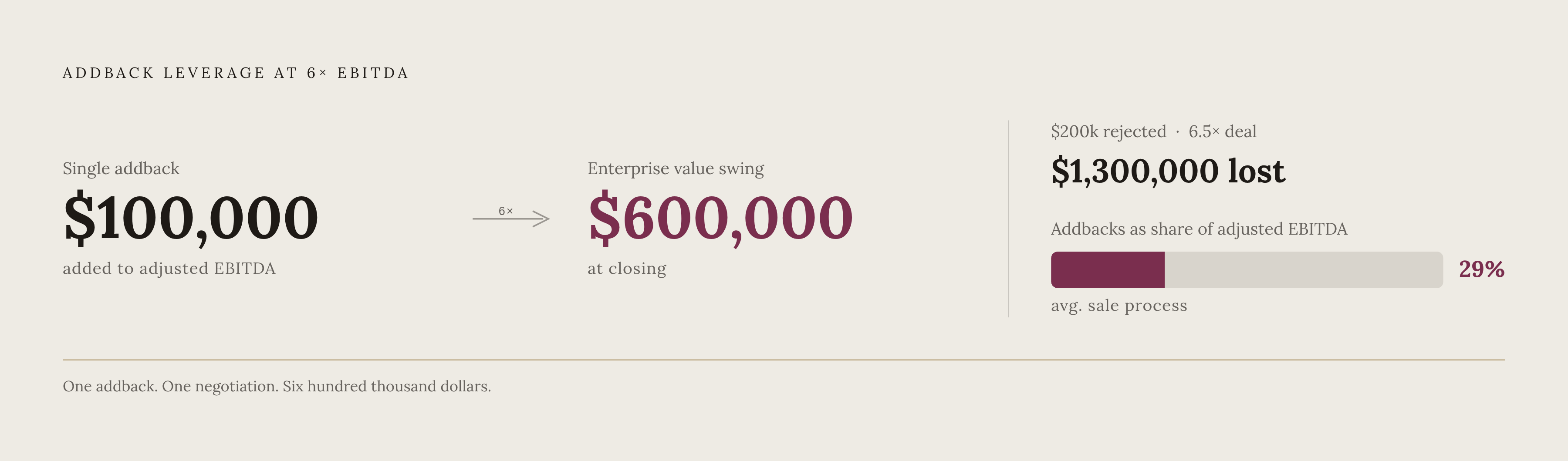
The math makes clear why sellers fight over line items that might look trivial on paper. At a 6x multiple, a single $100,000 addback swings enterprise value by $600,000. Scale that up: on a multi-million dollar deal priced at 6.5x, $200,000 of addbacks that a buyer's team rejects during diligence costs the seller several times that amount at the closing table. Addbacks routinely make up 29% of adjusted EBITDA in the average sale process, a substantial share rather than a rounding exercise. It's close to a third of the number everyone is negotiating around.
What separates a defensible addback from one that collapses in due diligence
The burden of proof sits entirely with the seller. Buyers do not accept an addback because it appears on a schedule with a plausible label attached. They accept it because it survives verification, and verification means source documents, not assertions from management about what an expense "really" was.
Four traits appear in every addback that makes it to closing. There's source documentation: invoices, signed contracts, payroll records, board minutes, the paper trail that exists independent of what the seller says happened. There's a credible narrative explaining why the item is genuinely non-recurring or tied specifically to the owner rather than the business. There's a benchmark for any claim resting on "market rate," whether that's a compensation survey or an independent rent appraisal. And there's categorization that holds up when a buyer's advisor lines it up against comparable deals they've underwritten before.
The prior-year test does more damage to seller addback schedules than any other single mechanism. If an "extraordinary" expense appears in each of the last three years, calling it one-time in year four does not survive a buyer's quality of earnings (QoE) analyst. QoE work reconstructs adjusted EBITDA from source documents, not from the seller's own recast, and analysts routinely test claims of non-recurrence against multiple years of financial history. An expense that pattern-matches to prior periods gets reclassified as recurring, full stop, and the seller loses the addback along with some credibility on every other line item nearby.
Owner compensation: the largest and most consistently accepted addback
Owner compensation normalization is the biggest addback category in lower middle market deals, and it isn't close. The logic is straightforward even when the numbers get contentious: reported owner compensation almost never reflects what the role would actually cost a buyer who has to hire someone to do the job after close.
Two scenarios run in opposite directions. In the overpaying case, a founder has been running a personal lifestyle through payroll for years, so total compensation sits well above what a hired CEO or general manager would command on the open market. In the underpaying case, the owner has minimized salary for tax reasons. Reported comp actually understates what a replacement executive would demand. Both situations require the same fix: swap out actual total compensation for a documented, market-rate replacement cost, and only the excess over that market rate qualifies as an addback.
This is where sellers who've read about seller's discretionary earnings (SDE) get tripped up moving into a deal priced on a different earnings-based valuation method. Under SDE, the full owner compensation comes out of the expense base, no questions asked. Under EBITDA, only the portion above market rate is addback territory. Confusing the two frameworks leads sellers to walk into negotiations with an inflated number that a buyer's advisor will correct within the first pass of diligence.
Owner perks and personal expenses run through the business
Personal vehicles, home expenses, life insurance policies, personal meals and travel, club memberships: these are the standard cast of characters in any owner-perks addback schedule, and buyers accept them routinely when the expense will genuinely disappear after the transaction closes. Health insurance premiums running through the business follow the same rule, accepted to the extent they exceed what the company would pay for a market-rate employee's benefit plan, not a dollar more.
The friction is visible in the documentation, not the concept. A conference trip billed to the business is defensible on its face. A family resort week tagged internally as a "client entertainment" expense is not, and any buyer's diligence team worth its fee will find the gap between the two. Acceptance runs medium when personal and business expenses blur together without a clean paper trail, and high when the seller can show, line by line, which dollars were personal and which were legitimate operating costs.
Above- or below-market related-party rent
A common structure in owner-operated companies: the seller holds the real estate in a separate legal entity and charges the operating company rent that has drifted away from market rates over the years, sometimes deliberately, sometimes just from inertia. The fix is to substitute an independent market rent determination for whatever the related-party lease actually says, then addback or subtract the difference.
This one cuts both ways, and sellers sometimes forget the downside version exists. Above-market rent charged to the operating company becomes an addback, since a new owner presumably renegotiates the lease or buys the real estate. Below-market rent, on the other hand, becomes a downward adjustment, because the business has been enjoying artificially cheap occupancy costs that won't necessarily continue. Because "market rent" isn't a single, agreed-upon figure, this category gets contested more often than most, with buyer and seller sometimes arriving at different conclusions about what market rate actually is.
One-time professional fees, transaction costs, and litigation settlements
Accounting fees, legal fees, investment banking fees tied to the current sale process: these are about as close to automatic addbacks as the category gets, because buyers understand these costs are an artifact of the transaction itself, not a recurring feature of running the business. The standard that governs acceptance is narrow but firm: fees must be tied to a documented transaction or event that actually happened, not to pipeline deals that might close someday.
Litigation is treated the same way when the underlying matter is discrete, resolved, and unlikely to recur, with supporting documentation as the required backup. The line that separates acceptable from unacceptable here is simple to state even when it's hard to apply: ongoing legal costs, the kind a company incurs as a normal cost of doing business, are generally not accepted as addbacks. A one-time expense tied to a genuinely rare legal event can be.
Non-cash and timing items: write-downs, accelerated depreciation, and deferred capex
Adjusted EBITDA already strips out depreciation and amortization by definition, so the additional adjustments in this category exist to correct distortions that sit beyond standard D&A treatment. Asset write-downs get accepted when they tie to a specific, identifiable event, an impairment on a discontinued asset line or an inventory write-off from exiting a product category, rather than reflecting a pattern that occurs every year in some form.
Accelerated depreciation schedules distort the cash-generation picture in the opposite direction, and buyers will addback the acceleration when it reflects a policy choice made for tax or accounting reasons rather than the actual economic life of the asset. Purchase accounting adjustments and the amortization of intangibles acquired in a prior deal appear in companies that have made acquisitions of their own, and their addback treatment depends on whether the underlying item represents a genuine distortion of ongoing earnings rather than a recurring economic cost.
The addbacks buyers consistently reject (and why they damage more than just the line item)
Eight categories appear repeatedly on rejection lists: normal capital expenditures, marketing investment, customer acquisition costs, working capital changes, recurring legal fees, sales commissions, employee bonuses, and ordinary travel. None of these are one-time. All of them are the ordinary cost of running the business, and dressing them up as extraordinary doesn't change what they are.
The most common failure mode is the recurring expense dressed up as a one-time event. A $195,000 equipment refurbishment labeled as an extraordinary, non-recurring cost falls apart the moment a buyer's analyst runs the prior-year test and finds a similar refurbishment charge sitting in the accounts in each of the last three years. Once that pattern becomes visible, the seller doesn't just lose that one addback. The buyer's team starts re-examining every other item on the schedule with new suspicion.
Run-rate synergies and projected cost savings deserve their own warning, since they account for roughly 26% of proposed addbacks in a typical process. Buyers will model these aggressively at the indication-of-interest stage, when competition for the deal is high and optimism is cheap, then discount them hard once diligence starts. Aggressive adjusted EBITDA assumptions built on synergies that don't materialize have driven leverage misses of more than 2.3x in some transactions, a gap large enough to turn a financeable deal into a distressed one. A pro forma claim that "this vendor contract gets renegotiated after close" is a hope, not an addback. It's a hope, and buyers don't pay multiples on hope.
The grey zone: addbacks that survive with the right facts and collapse without them
Some categories don't have a clean yes or no answer, and the outcome depends as much on who's sitting across the table as it does on the merits of the addback itself. Sophisticated buyers with experienced diligence teams interrogate these line items hard. Less experienced teams, or lenders under pressure to hit a covenant target, sometimes wave them through. The quality of the buyer's team ends up shaping the outcome nearly as much as the quality of the addback does.
Pro forma or run-rate adjustments tied to a recent acquisition are squarely in this territory. If a company bought a competitor mid-year, there's a real argument for showing the acquired business's full-year contribution to EBITDA rather than the partial-year figure that appears on the books. But that adjustment is forward-looking by construction, which makes it inherently more speculative than an addback resting on completed, historical transactions.
Restructuring costs follow a similar logic. They're defensible when the restructuring is genuinely concluded and won't repeat. They're indefensible when the company has run some version of a restructuring charge every year for the past several years, at which point the multi-year pattern test applies exactly as it does everywhere else in this analysis. Sophisticated buyers scrutinize each adjustment on its own merits, applying more skepticism as the credibility of the underlying support weakens. Nothing about this process is binary, and sellers who expect an all-or-nothing outcome usually leave money on the table by not pressing the moderate-credibility items harder.
How downward adjustments by buyers offset seller addbacks
Every addback conversation eventually runs into its mirror image. Buyers build their own list of costs the seller never carried, and those downward adjustments eat directly into the number the seller thought was locked in. Below-market rent appears here again, this time from the other direction: a company that owns its building outright and charges itself nothing is quietly understating its true occupancy cost. Inadequate insurance coverage, deferred maintenance, unfunded pension or benefit obligations all work the same way, raising real costs the business has been avoiding rather than eliminating.
Owner salary below market rate is the sharpest version of this problem, because it can turn a seller's favorite addback into a net negative. When a founder has been drawing a below-market salary, the buyer's model credits that actual salary back into EBITDA, since the expense goes away at close, but then subtracts what a market-rate replacement executive would actually cost to hire. That replacement cost is almost always higher than what the founder was paying themselves, so the seller walks in expecting an addback and walks out with a downward adjustment instead. Deferred capex plays a similar role: capital investment the business postponed to make the numbers look better heading into a sale doesn't vanish, it just becomes the buyer's first-year expense, and buyers price that reality into the offer before a single document gets signed.
